# Introduction

Welcome to the Private Pools Network (PPN) documentation! Here, you'll find all the information you need to get started with and effectively utilize the features offered by out protocol.

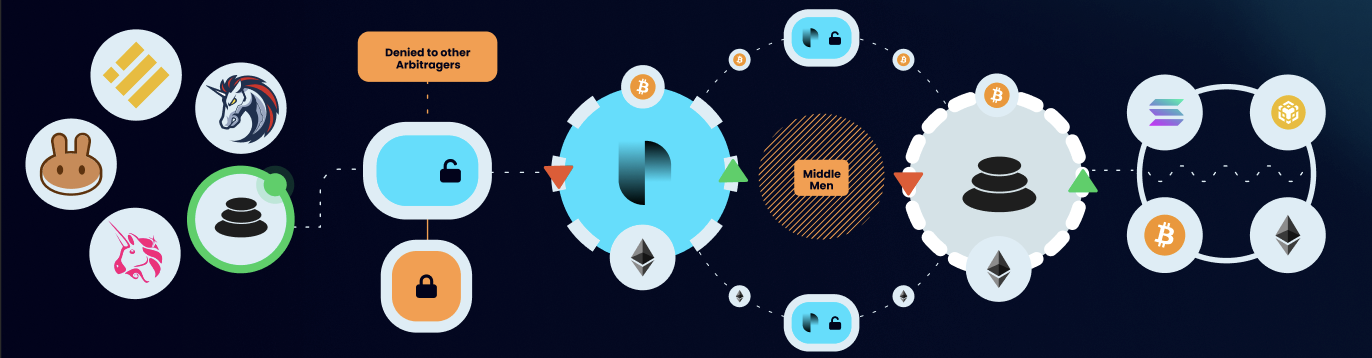
<figure><img src="https://1180540342-files.gitbook.io/~/files/v0/b/gitbook-x-prod.appspot.com/o/spaces%2Frl3dSIdUNdPAk43XA8d6%2Fuploads%2FOrNuR9QyE2ZyOkF9kBsk%2FX_2.png?alt=media&amp;token=a7be2712-698c-493d-9a11-3a5a69bddfc6" alt=""><figcaption></figcaption></figure>

## Empowering Access to Automated Arbitrage Strategies

{% hint style="info" %}
**Simplified TLDR;**\
Private Pools Network extracts value from volatility (the ups and downs in market prices). We do so by a process known as Arbitrage. \
\
What makes us special from your "run of the mill" [arbitrage](broken://pages/X3tqsKLlaUA5F4eIqiDV#arbitrage) bot is that we restrict interaction with our liquidity pools so only our trading engine can interact with them. This establishes a "[Private Order Flow](broken://pages/X3tqsKLlaUA5F4eIqiDV#private-order-flow)" business model. \
\
This results in yield extraction opportunities that are exclusive and unique to our ecosystem. \
\
**In short we;**\
\- Optimize the arbitrage process by circumventing middle men (extracting up to 80% more value by avoiding[ PGA](broken://pages/X3tqsKLlaUA5F4eIqiDV#priority-gas-auctions)'s) \
\
\- Monetize [Impermanent Loss](broken://pages/X3tqsKLlaUA5F4eIqiDV#impermanent-loss) and [Toxic Order Flow](broken://pages/X3tqsKLlaUA5F4eIqiDV#toxic-order-flow) (The negative aspects of supplying to LP's that usually see your LP position lose value) \
\
\- Monolopize the Volatility Farming landscape&#x20;
{% endhint %}

{% hint style="success" %}
The liquidity you deposit into our ecosystem is used as counter liquidity for rebalancing pools in the arbitrage process. By privatizing the flow of this liquidity we eliminate competition and circumvent middle men meaning we extract more value. \
\
The choice is simple, **you can arbitrage with us or be arbitraged by us**. We extract value where value is lost in traditional AMM settings.&#x20;
{% endhint %}

<figure><img src="https://content.gitbook.com/content/rl3dSIdUNdPAk43XA8d6/blobs/8gk7j0qY4Ro3aEi5jBPi/image.png" alt=""><figcaption><p>Private Pools Network leverages your liquidity to extract yield from volatility </p></figcaption></figure>

## High-Level Introduction

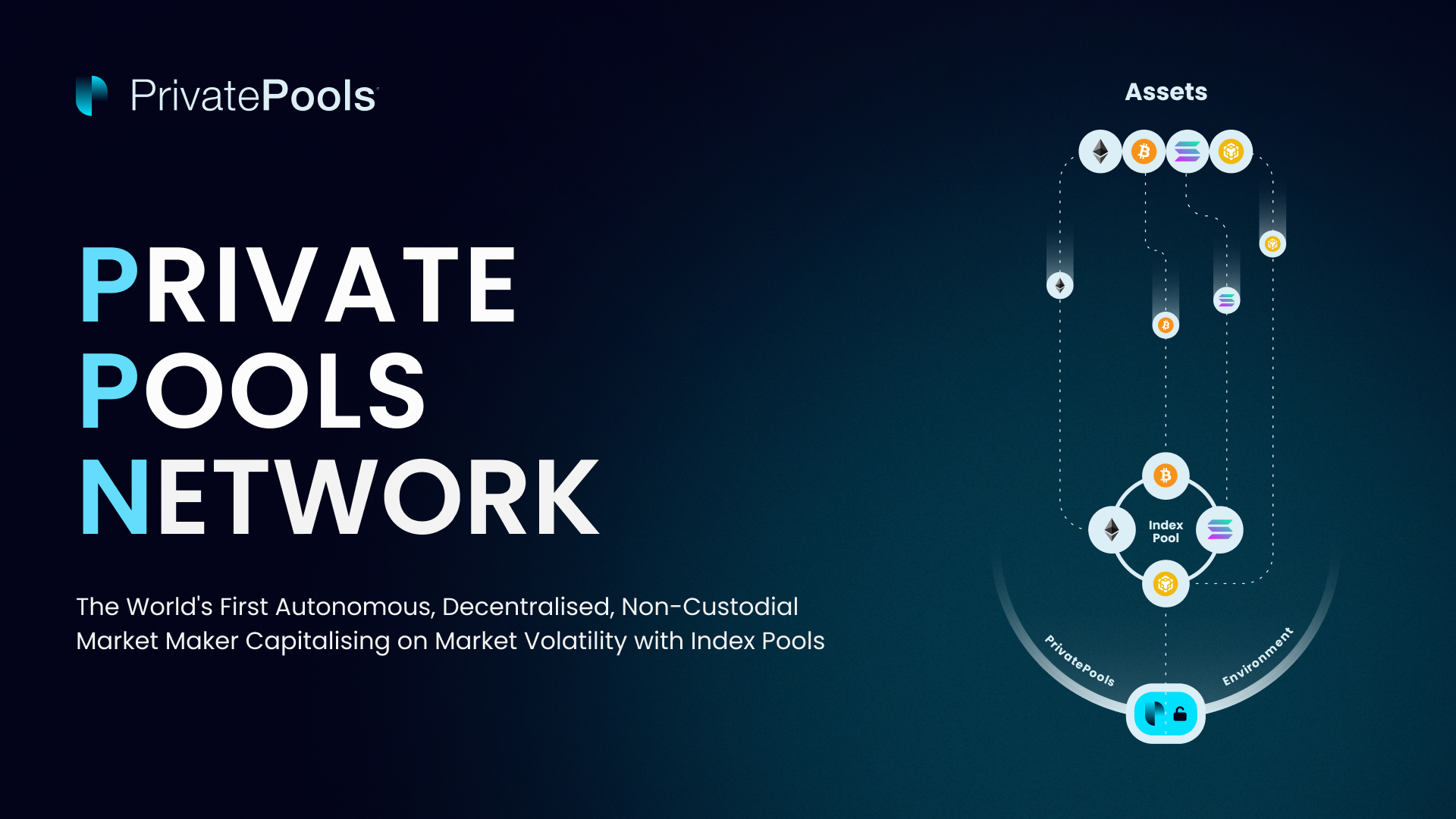
A high-level view of the Private Pools Network describes the system as a blockchain-based architecture focused on a fully automated index fund creation, deployment, and management.&#x20;

These Index funds "[Private Index Pools](broken://pages/X3tqsKLlaUA5F4eIqiDV#private-index-pool)" (PIP's) are a novel approach to incentivising liquidity and extracting value from external liquidity sources. In short, Private Pools Network can be described the worlds first "Fully Automates, Decentralized, Non-custodial, On-chain Market Maker.&#x20;

PPN's smart contract ecosystem allows the user to deploy liquidity into a wide range of asset compositions ([Indexes](broken://pages/X3tqsKLlaUA5F4eIqiDV#private-index-pool)), providing diverse exposure to the crypto market. With automated rebalancing capabilities, our system maintains the assets in the index pools at balance with the open market according to the preconfigured weights while generating yield for our users in the process of rebalancing, achieved through our algorithms via automated arbitrage [trading engine logic. ](/ecosystem/architecture/trading-engine)


# Product Goal

This section provides insights into what drives us, what we aim to accomplish, and how our platform contributes to addressing your needs and challenges.

> **Simplified TLDR**\
> Our goal is to maximize the efficiency of liquidity by focusing on extracting value from volatility ([Arbitrage](broken://pages/X3tqsKLlaUA5F4eIqiDV#arbitrage)) through our [Privatized Order Flow model](broken://pages/X3tqsKLlaUA5F4eIqiDV#private-order-flow), rather than the current approach that emphasizes extracting value from fees (standard AMM model).\
> \
> [Toxic Order Flow](broken://pages/X3tqsKLlaUA5F4eIqiDV#toxic-order-flow) (TOF) and [Impermanent Loss](broken://pages/X3tqsKLlaUA5F4eIqiDV#impermanent-loss) (IL) have resulted in protocols undertaking unsustainable processes for incentivizing liquidity provision. This has created a massive problem in DeFi. Users now receive minuscule 'real yield' from swap fees alone, and as TOF and IL intensify, protocols are forced to take unsustainable approaches to retain sticky liquidity. This results in rapidly deteriorating token prices due to high inflation and heavy reliance on foundational grants. We're here to flip that narrative on its head.&#x20;

{% hint style="info" %}
The impacts of [Toxic Order Flow](broken://pages/X3tqsKLlaUA5F4eIqiDV#toxic-order-flow) and [Impermanent Loss](broken://pages/X3tqsKLlaUA5F4eIqiDV#impermanent-loss) have significantly contributed to the decline in dominance of decentralized exchanges (DEXs) within the DeFi sector. The loss in DEX TVL & thus fees is primarily derived from the inability of liquidity provision platforms to outperform losses from toxic flows without relying on [unsustainable token incentives](broken://pages/X3tqsKLlaUA5F4eIqiDV#unsustainable-token-incentives).
{% endhint %}

<figure><img src="https://1180540342-files.gitbook.io/~/files/v0/b/gitbook-x-prod.appspot.com/o/spaces%2Frl3dSIdUNdPAk43XA8d6%2Fuploads%2FnZR0aYJ5aAyzIvuBJys1%2FX_1.4.png?alt=media&amp;token=70c8037c-a98f-4861-b274-116f5d449498" alt=""><figcaption><p>Decline of Balancer fees over time due to over exposure to impairment loss &#x26; toxic flows</p></figcaption></figure>

## The choice is yours: Arbitrage or be arbitraged!

The primary goal of Private Pools Network is to overcome traditional AMM Systems' limitations by internally executing arbitrage rebalancing to provide an improved risk-return profile to liquidity providers. Index Funds currently hold nearly half of the total market share of traditional markets. However, in Decentralized Finance, the popularity of index fund pools seems relatively lacklustre.

It cannot be denied that the risks of underperformance against LVR (Loss-Versus-Rebalancing) due to Toxic Flows and Impermanent Loss play a significant part in making various potential index compositions obsolete. Private Pools Network aims to address the issues blocking the generalized use of decentralized interest-paying index funds by capitalizing on toxic flows and monetizing them in favor of our liquidity providers.

In simple terms, The Private Pools Network objective at launch is to sufficiently improve the returns profile to mitigate Impermanent Loss risks in traditionally toxic liquidity pools, thus allowing Liquidity Providers to generate returns on their assets, while overperforming the LVR benchmark ([Milionis, J., Moallemi, C. C., Roughgarden, T., & Zhang, A. L. (2023)](https://arxiv.org/pdf/2208.06046.pdf)).

The long-term goal of the Private Pools Network Protocol is to entirely address the [Toxic Flow](broken://pages/X3tqsKLlaUA5F4eIqiDV#toxic-order-flow) and [Impermanent Loss](broken://pages/X3tqsKLlaUA5F4eIqiDV#impermanent-loss) issue through trading engine and profit distribution optimizations capable of allowing the retention of value from toxic flows back to the Liquidity Providers while charging a protocol fee for mean reversion trades, which are inherently nontoxic and profit-generating.

This design aims to address the Impermanent Loss issue entirely, adequately protecting Liquidity Providers from Impermanent Loss risks and allowing for the monetization of typically considered toxic index pool compositions. The ultimate objective is to create yield-generating distributed risk investment vehicles.

Achieving the goals defined above could target the TVL, which left AMM architectures due to Impermanent Loss risks.


# Glossary

Here you can find the meanings behind any industry specific jargon that you might find confusing. We hope this helps define some of the terminology used within this these documentation.

<details>

<summary>Arbitrage</summary>

Crypto arbitrage depicts the process of capitalizing from price deviations of a cryptocurrency assed between a variety of exchanges or marketplaces. In this process a trader would buy an asset for a lower price on one exchange and sell the asset on another exchange, at a higher price. The deviation between the price spreads is recognised as profit. \
\
***Arbitrage example - Tim buys ETH for $1000 on Binance and sells it on UniSwap for $1010. His net profit is $10. This is an example of a successful CEX - DeFi arbitrage trade.***&#x20;

</details>

<details>

<summary>External Liquidity Sources</summary>

Sources of liquidity that Private Pools Network interacts with outside of our ecosystem. Price deviations between these liquidity sources and ratios within our Private Index Pools, allow our trading engine to buy or sell from one liquidity source to rebalance with our Private Index Pools, resulting in profitable yield extracted in the process. \
\
***Examples of decentralized external liquidity sources would be DEX LP's such as UniSwap, PancakeSwap, SushiSwap e.t.c.***  \
\
***Examples of centralized external liquidity sources would be order books accross Binance, HTX, Coinbase, ByBit, OKEx e.t.c***

</details>

<details>

<summary>Impermanent Loss </summary>

Impermanent Loss is a risk faced by liquidity providers in decentralized exchanges (DEXs) like Uniswap. It happens when the value of assets in a liquidity pool changes compared to when they were deposited. This results in liquidity providers receiving fewer assets than they initially deposited, even when factoring in trading fees.

</details>

<details>

<summary>Priority Gas Auctions</summary>

A priority gas auction in blockchain allows users to bid higher gas fees to speed up transaction processing. Miners prioritize transactions with higher fees, incentivizing faster processing for those willing to pay more. This is a major flaw in the current arbitrage process. Due to the public nature of liquidity pools, arbitragers often race to zero as they bid for blockspace to get their order processed before the competition does. This often leads to up to 80% of the value extracted from arbitrage lost as an overhead to pay the validator.&#x20;

</details>

<details>

<summary>Private Index Pool</summary>

A Private Index Pool (PIP) is our innovative approach to liquidity provision. Utilizing Balancer architecture, we create various balanced and index LP positions designed specifically to serve as counter-liquidity in the arbitrage process. We chose Balancer because it is both battle-tested and ideally suited to accommodate the diverse assets our protocol requires to maximize arbitrage opportunities. By hosting a variety of assets in an index, we enhance our network effect, fostering an environment conducive to triangular arbitrage. Additionally, this strategy provides the fringe benefit of diversified exposure against a single asset.

</details>

<details>

<summary>Private Order Flow</summary>

Privatized orderflow is what makes our model unique. DeFi orderflow is inherantly public (Public Order Flow). This is what enables users of DeFi to freely trade in and out of liquidity sources. However, the public nature of standard order flow means Liquidity Sources such as DEX LP's, are pillaged by MEV opportunists leading to value loss within LP positions (due to impermanent loss) and a huge amount of wastage (due to PGA's) in the process. We flip this model on its head, by restricting access to our index pools, allowing only our Trading Engine to interact with them, we cultivate an environment that establishes a privatize order flow, to which we extract value from external liquidity sources.&#x20;

</details>

<details>

<summary>Toxic Order Flow </summary>

Toxic Order Flow refers to the risk in trading where one party exploits private or privileged information to gain an unfair advantage over others. This can lead to market makers providing liquidity at a loss, impacting market stability. In DeFi, it often involves practices like front running, where transactions are exploited for profit.

</details>

<details>

<summary>Unsustainable Token Incentives</summary>

Unsustainable token incentives is a subjective phrase, but used in our documentation to depict the incumbent process of relying on external funding (such as grants) from foundations (such as the Arbitrum Foundation) or relying on a high emissions schedule, to sufficiently incentivize liquidity as a means of outpacing Toxic Order Flows or Impermanent Loss.

</details>


# Research

In this page we present out research findings that lead to the conception of Private Pools Network, a means of farming market volatility.

## Our research is broken down into 3 main categories:<br>

{% content-ref url="/pages/iWX1cNMAgnrJcBULlMpt" %}
[The problem](/overview/research/the-problem)
{% endcontent-ref %}

{% content-ref url="/pages/eVKeioFy5iYXTy8bjXZw" %}
[The Opportunity](/overview/research/the-opportunity)
{% endcontent-ref %}

{% content-ref url="/pages/SBPfxDqfRVdrP0CV5Tu5" %}
[Resources](/overview/research/resources)
{% endcontent-ref %}


# The problem

Examining the problem that presents our opportunity (to Monetize value that is traditionally lost in AMM order flow)

## Preface - Our Origin Story&#x20;

Our Origin story takes place after realizing the persistent problems in the liquidity landscape from our own experiences, we saw the need for a robust solution. Driven by our frustration in experiencing first hand the challenges of capital inefficiency and negative nuances in liquidity provision we embarked on our journey to seek a solution to the DeFi liquidity problem. \
\
During our research phase, our team came across a research report titled "[A tale of two arbitrages"](https://frontier.tech/a-tale-of-two-arbitrages). It conceived the notion that Impermanent Loss & Toxic Order Flow could be monazite under the right conditions. Diving deeper, our eyes were opened to the size of the [opportunity](/overview/research/the-opportunity) that was presented before us, a potential to monopolize a potential billion dollar market vertical by simply privatizing the order flow within the volatility market. With this a plan was conceived to develop a groundbreaking liquidity solution under the umbrella of Private Pools Network. What resulted was an intense 12 month research & development process resulting in the worlds first, **autonomous**, f**ully decentralised**, **non-custodial,** **on- chain market maker.**&#x20;

## Research Report Summary: Problems with Public Order Flow

### **Introduction**

This report examines the challenges associated with public order flow in decentralized finance (DeFi), focusing on how it negatively impacts regular liquidity providers (LPs) and leads to substantial wastage of extracted yield. The discussion is divided into two primary issues: the adverse effects on LPs and the inefficiencies arising from the public nature of order flow, particularly the problem of Priority Gas Auctions (PGAs).

### **Impact on Liquidity Providers (LPs) - The three pillars of a perfect storm**

#### **Toxic Order Flow**

Toxic order flow refers to the scenario where informed traders (informed searchers) execute trades based on information not available to the general market, such as external signals or private order flow data. This results in significant disadvantages for regular LPs, who are often unaware of the impending trades that will adversely affect their positions.

{% hint style="info" %}
**Mechanism**: Informed traders use their superior information to conduct trades that capitalize on future price movements. For instance, if an informed trader knows that a large buy order is about to be executed on a centralized exchange, they can preemptively buy the same asset on a decentralized exchange, leading to a price increase that disadvantages existing LPs.
{% endhint %}

{% hint style="info" %}
**Impact on LPs**: LPs provide liquidity based on current market conditions and available information. Toxic order flow disrupts these conditions, causing unexpected price shifts and losses for LPs. This erodes the profitability of liquidity provision, making it less attractive for regular participants.
{% endhint %}

#### **Impermanent Loss**

Impermanent loss occurs when the price of assets within a liquidity pool changes relative to each other, leading to a loss for the LP compared to simply holding the assets.

{% hint style="info" %}
**Mechanism**: When informed traders exploit arbitrage opportunities, they cause significant price movements within the pool. LPs incur losses as the prices realign to the broader market, particularly if they withdraw their liquidity during these price changes.
{% endhint %}

{% hint style="info" %}
**Impact on LPs**: Regular LPs suffer from these price fluctuations, which are often induced by informed traders' activities. The result is a lower return on their investment, further disincentivizing liquidity provision.
{% endhint %}

#### **Volatility**

Volatility in the market exacerbates the negative impacts of toxic order flow and impermanent loss.

{% hint style="info" %}
**Mechanism**: High volatility leads to more frequent and larger price swings. Informed traders thrive in such environments, extracting more value through arbitrage and other strategies.
{% endhint %}

{% hint style="info" %}
**Impact on LPs**: Regular LPs face increased risk and potential losses due to the unpredictable nature of volatile markets. Their liquidity positions become more susceptible to adverse movements, diminishing the overall appeal of providing liquidity.
{% endhint %}

### **Suboptimal Process of Arbitrage and Wastage of Extracted Yield**

#### **Public Nature of Order Flow and PGAs**

The public nature of order flow in DeFi creates a competitive environment where multiple participants vie to execute profitable trades first. This leads to Priority Gas Auctions (PGAs), where traders bid up gas prices to ensure their transactions are prioritized.

{% hint style="info" %}
**Mechanism**: In a PGA, traders engage in a bidding war, driving up the transaction fees to get their orders included in the next block. This is common in arbitrage opportunities where being the first to execute the trade is crucial.
{% endhint %}

{% hint style="info" %}
**Impact on Value Extraction**: A significant portion of the potential value extracted through arbitrage is lost to these bidding wars. Estimates suggest that up to 80% of the value is wasted in PGAs, as it is transferred to validators and block builders rather than the traders themselves.
{% endhint %}

#### **Validator and Block Builder Dominance**

Due to PGAs, validators and block builders receive the lion's share of the value extracted from volatility and arbitrage opportunities.

{% hint style="info" %}
**Mechanism**: Validators prioritize transactions based on the gas fees offered. As traders increase their bids to secure execution, validators collect higher fees, diverting a substantial portion of the arbitrage profits to themselves.
{% endhint %}

{% hint style="info" %}
**Impact on Yield**: The excessive gas fees paid during PGAs result in diminished net profits for arbitrage traders. This inefficiency means that the overall system is less effective at capturing and distributing value, with a large part of the yield being absorbed by transaction costs rather than benefiting the broader DeFi ecosystem.
{% endhint %}

### Example of the Problem Statement

<figure><img src="https://1180540342-files.gitbook.io/~/files/v0/b/gitbook-x-prod.appspot.com/o/spaces%2Frl3dSIdUNdPAk43XA8d6%2Fuploads%2FpgUlOSF3aoL35oESTp07%2FX_5.6.png?alt=media&amp;token=4aeb304a-7fdc-4ef3-9050-2fb6aacdf39b" alt=""><figcaption></figcaption></figure>

The image above denotes a perfect depiction of both problem statements highlighted in our research summary above. Between May 2023 - May 2024 prominent block builder "Beaver Build" played part in extracting $150,000,000 worth of value extracted from volatility.&#x20;

#### Significance in relation to the impact on LP's&#x20;

Simply put, this $150,000,000 of value extracted in the example above wasn't manifested from thin air, it came at the expense of LP providers. In the process of rebalancing pool ratios from one liquidity source with another the value extracted came directly from liquidity providers. This is your hard earned money being bleed dry.

#### Significance in relation to process inefficiency & wastage&#x20;

Not only does this process impact the viability, profitability and purpose of liquidity providers, but the process in which this value is extracted is horribly inefficient. Aligning closley with the findings of the research report "[A Tale of Two Arbitrages](https://frontier.tech/a-tale-of-two-arbitrages)" we see yield allocations of the value extraction process as follows.&#x20;

* $150 Million value extracted total&#x20;
* $128 Million combined value to validators & block builders (85.33%)
* $19 Million value extracted as realized net profit by arbitragers (12.66%)
* 100% loss across liquidity pools to which value was extracted

In this scenario:&#x20;

* Arbitragers eat away at and devalue liquidity positions&#x20;
* Block builders and validators monopolize block space (eating away at the validators gross profits)
* Liquidity providers suffer impermanent loss resulting from toxic order flow

**Conclusion**

The problems associated with public order flow in DeFi present significant challenges. Toxic order flow, impermanent loss, and volatility disproportionately harm regular LPs, making liquidity provision less attractive. Additionally, the suboptimal process of arbitrage, exacerbated by PGAs, leads to substantial wastage of extracted yield, with validators and block builders capturing the majority of the value.&#x20;

Addressing these issues requires innovative solutions to protect LPs and improve the efficiency of value extraction in the DeFi ecosystem, and with that, our opportunity is realized. Read on to discover how we capture this opportunity in our solution.&#x20;


# The Opportunity

In this segment of our documents, we examine the market size of value extracted from volatility as we traverse how our solution stands to capitalize on this market opportunity.

Market Opportunity Size

{% hint style="info" %}
Assessing the magnitude of the arbitrage market presents significant challenges due to various factors
{% endhint %}

### Factors for Fragmentation of Arbitrage Data

* **Multiple Blockchain Networks**: Different blockchain networks support liquidity, leading to a vast amount of data to analyze.
* **On-Chain vs. Off-Chain Arbitrage**: While atomic arbitrage can be quantified on-chain, much arbitrage occurs between CeFi (Centralized Finance) and DeFi (Decentralized Finance), where off-chain settlement makes quantification impossible.
* **Validators and Block Builders**: Each blockchain has its own set of validators and block builders, some with publically available data, others with data that isnt so public or easy to scrape. This further complicates quantification efforts.

Despite these challenges, insights can be gleaned by examining a segment of the market. For instance, the value extracted from arbitrage within the Flashbots ecosystem on Ethereum provides a case study. Flashbots, one of Ethereum's major block builders, reported approximately $73,000,000 in value extracted by validators post-merge. Assuming similar data from the other two major block builders, we estimate a total value of roughly $219,000,000 extracted from volatility on Ethereum alone.

### Analysis of Binance Smart Chain (BSC)

Examining Binance Smart Chain (BSC) using block builder data retrieved from [Eigen Phi](https://eigenphi.io/), we observe that over the past 30 days, validators have benefited to the tune of almost $22 million in value extracted from arbitrage. Even though this constitutes only a fraction of the value actually extracted due to data fragmentation, extrapolating an annualized average suggests that a minimum of $264 million in value is extracted from BSC each year.

This presents a monumental opportunity for our ecosystem to capitalize on, potentially cornering the market in the process.

<figure><img src="https://1180540342-files.gitbook.io/~/files/v0/b/gitbook-x-prod.appspot.com/o/spaces%2Frl3dSIdUNdPAk43XA8d6%2Fuploads%2FOFkgd2Eb8bK0byBbSF4s%2FX_5.232.png?alt=media&amp;token=5caeca5f-10e8-4dfe-9898-c0ea41d29572" alt=""><figcaption></figcaption></figure>

### Analysis of the Ethereum (ETH) Ecosystem

From May 2023 - May 2024, data presented from the [LIB MEV](https://libmev.com/bundles/?timestampRange=%5B1683062246511.6%2C0%5D\&mevTypeLabels=%5B%22Arbitrage%22%5D\&mevBreakdowns=%5B%22Profit%22%2C%22Tipped%22%2C%22Burned%22%5D) dashboard that $150 million has been extracted from volatility farming on the Ethereum network. This concept, which our protocol intends to capitalize on, is still underexplored and holds substantial market potential.

* **Opportunity Breakdown**: Of the $150 million reported, only a fraction of arbitrage profits are extracted by the arbitrager—$19 million or 12.66% to be exact. This is due to the wastage inherent in the arbitrage process due to "Public Order Flow," leading to Priority Gas Auctions (PGAs).
* **Priority Gas Auctions (PGAs)**: Due to the public nature of blockchain transactions, arbitrage opportunities are inherently public. This leads to a bidding war for block space to process transactions like arbitrage opportunities. Arbitragers pay excessive gas fees to snipe the arbitrage trade before others, significantly reducing their profits.
* **Data Fragmentation**: The reported figures are incomplete, representing only on-chain (atomic) arbitrage. [Research presented by Frontier Tech](https://frontier.tech/a-tale-of-two-arbitrages) indicates that 60% of arbitrage opportunities (by revenue) occur via CeFi-DeFi arbitrage, which involves off-chain components and remains difficult to quantify accurately.

<figure><img src="https://1180540342-files.gitbook.io/~/files/v0/b/gitbook-x-prod.appspot.com/o/spaces%2Frl3dSIdUNdPAk43XA8d6%2Fuploads%2FpMYAqEzJV3Yu5MeurKsS%2FX_5.6.png?alt=media&amp;token=a5a77f03-c066-493b-9f97-746fec8dc3e1" alt=""><figcaption></figcaption></figure>

### Key Takeaways

1. **Impact on Liquidity Providers (LPs)**: The current process directly impacts LP participants by devaluing their positions and leading to a loss of pooled assets. This lost value is extracted by opportunists in the MEV and arbitrage landscape.
2. **Inefficiency in Value Extraction**: The current system is highly inefficient, with over 80% of value being handed to block builders and validators due to PGAs.
3. **Market Size**: The $150 million figure represents a fraction of the actual market size. Considering the fragmented data and the exclusion of CeFi-DeFi arbitrage, the true market opportunity on the Ethereum chain alone might well exceed $1 billion annually.

### Optimization and Our Solution

Optimization of this process could involve extracting the value lost by LPs and returning it to a purpose-built ecosystem aimed at solving the "Liquidity Problem" in DeFi.

### Private Pools Network - Our Mandate

* **Privatize Order Flow**: To eliminate competition and circumvent PGAs.
* **Compose Purpose-Built Indexes**: To act as counter liquidity.
* **Engage Trading Engine**: As the sole entity permitted to interact with private index pools.
* **Identify Price Deviations**: On external liquidity sources caused by volatility.
* **Enhance Value Extraction**: By over 80%.
* **Arbitrage External Liquidity**: And return the lost value back to our ecosystem.

### Conclusion

The choice is evident: arbitrage your own liquidity with Private Pools Network, or someone else will. Monetize the value you lose daily or continue allowing your liquidity positions to be depleted by other actors.<br>


# Resources

Below is a list of resources that support & validate the inefficiencies of "Liquidity Problem" the size of our "Market Opportunity", used as part of our research in the development of Private Pools.

## APIs and Inspection Tools:

[LIB MEV Arbitrage Dashboard (ETH only) ](https://libmev.com/bundles/?mevTypeLabels=%5B%22Arbitrage%22%5D)

[FlashBots MEV](https://github.com/flashbots/mev-inspect-py)

[Eigen Phy MEV Dashboard](https://www.eigenphi.io/)

## &#x20;Research Papers:

[A Tale of Two Arbitrages ](https://frontier.tech/a-tale-of-two-arbitrages)

[A new Game in Town](https://frontier.tech/a-new-game-in-town)

[The Value of Nontoxic Orderflow to the Uniswap Protocol](https://xenophonlabs.com/papers/uniswap_valuing_orderflow.pdf)

## Contant Fuction MM Papers:

[A General Framework for Impermanent Loss in Automated Market Makers](https://arxiv.org/abs/2203.11352)

[An analysis of Uniswap markets](https://angeris.github.io/papers/uniswap_analysis.pdf)

[Optimal Routing for Constant Function Market Makers](https://web.stanford.edu/~boyd/papers/pdf/cfmm-routing.pdf)

[Towards a Theory of Maximal Extractable Value I: Constant Function Market Makers](https://arxiv.org/abs/2207.11835)

## Frontrunning and MEV in Blockchain:

[Flash Boys 2.0: Frontrunning, Transaction Reordering, and Consensus Instability in Decentralized Exchanges](https://arxiv.org/pdf/1904.05234.pdf)

[Quantifying Blockchain Extractable Value: How dark is the forest?](https://arxiv.org/pdf/2101.05511.pdf)

[Frontrunner Jones and the Raiders of the Dark Forest: An Empirical Study of Frontrunning on the Ethereum Blockchain](https://arxiv.org/pdf/2102.03347.pdf)

[Unity is Strength: A Formalization of Cross-Domain Maximal Extractable Value](https://arxiv.org/pdf/2112.01472.pdf)

[A Note on Bundle Profit Maximization](https://angeris.github.io/papers/flashbots-mev.pdf)

[A 2MM: Mitigating Frontrunning, Transaction Reordering and Consensus Instability in Decentralized Exchanges](https://arxiv.org/pdf/2106.07371.pdf)

[MEV in eth2 - an early exploration](https://hackmd.io/@flashbots/mev-in-eth2)

[MEV and EIP-1559](https://hackmd.io/@flashbots/MEV-1559)

[Ethereum Reorgs After The Merge](https://www.paradigm.xyz/2021/07/ethereum-reorgs-after-the-merge/)

[MEV-Synthetix](https://bertcmiller.com/2021/09/05/mev-synthetix.html)

[The Future of MEV is SUAVE](https://writings.flashbots.net/the-future-of-mev-is-suave/)

[Time, slots, and the ordering of events in Ethereum Proof-of-Stake](https://www.paradigm.xyz/2023/04/mev-boost-ethereum-consensus)

[Searching on MEV-Share](https://t.co/t32QmDt6ws)&#x20;

## Decentralized Exchanges and Defi:

&#x20;[Decentralised Finance and Automated Market Making: Execution and Speculation](https://papers.ssrn.com/sol3/papers.cfm?abstract_id=4144743)

[SoK: Decentralized Exchanges (DEX) with Automated Market Maker (AMM) Protocols](https://arxiv.org/pdf/2103.12732.pdf)

[The fastest draw on the Blockchain: Ethereum Backrunning](https://amanusk.medium.com/the-fastest-draw-on-the-blockchain-bzrx-example-6bd19fabdbe1)

[Ethereum is a Dark Forest](https://www.paradigm.xyz/2020/08/ethereum-is-a-dark-forest)

[Escaping the dark forest](https://samczsun.com/escaping-the-dark-forest/)

[Backrunning the MEV Crisis](https://medium.com/dragonfly-research/we-live-in-a-mempool-backrunning-the-mev-crisis-a4ea0b493b05)

[There is Light in the Dark Forest](https://medium.com/bloxroute/there-is-light-in-the-dark-forest-2d7b77f4ca2d)

[Unmasking the Ethereum uncle bandit](https://medium.com/alchemy-api/unmasking-the-ethereum-uncle-bandit-a2b3eb694019)

[Bertcmiller Tweet](https://twitter.com/bertcmiller/status/1382673587715342339)

[To sink Frontrunners, send in the Submarines](https://hackingdistributed.com/2017/08/28/submarine-sends/)&#x20;

[The enemy of your enemy is NOT your friend](https://fiona.mirror.xyz/QXdCOAggA5g_j5R_JpO-V5LqK89EbimnYIV6c2rOsT0)&#x20;

[Hack Analysis 0xbad Exploiting an MEV Bot](https://medium.com/immunefi/0xbadc0de-mev-bot-hack-analysis-30b9031ff0ba)

[MEV Transaction Ordering For Profit and Fun](https://mixbytes.io/blog/mev-defi-transaction-ordering-for-profit-fun)

[Salmonella](https://github.com/Defi-Cartel/salmonella)

[Flashbots Limit Order Bot](https://docs.flashbots.net/flashbots-mev-share/searchers/tutorials/limit-order/introduction)


# Overview

Private Pools Network pools offers diversified exposure, improved capital efficiency, and higher profitability.

## Pools Types

{% content-ref url="/pages/3zMpsD2q5xV567LuK8YI" %}
[Weighted Pools (WP)](/pools/weighted-pools-wp)
{% endcontent-ref %}

{% content-ref url="/pages/QvxagdFnQ6FJtOND2Zv9" %}
[Custom Pools (CP)](/pools/custom-pools-cp)
{% endcontent-ref %}

{% content-ref url="/pages/4hXyF7Z5FLioAhaC0Kwg" %}
[Concentrated Liquidity Pools (CLP)](/pools/concentrated-liquidity-pools-clp)
{% endcontent-ref %}


# Weighted Pools (WP)

## Overview

Weighted Pools represent an advancement of the traditional  x \* y = k Automated Market Maker (AMM) model initially introduced by Uniswap v1. These pools utilize Weighted Math, making them suitable for a broad range of scenarios, including those involving tokens without inherent price correlation, such as USDT and WETH.

$$
x\*y=k
$$

Unlike conventional AMM pools, which are typically constrained to a 50/50 weighting structure, PrivatePool's Weighted Pools offer enhanced flexibility. They allow users to create pools with more than two tokens and to assign custom weightings, such as 80/20 or 60/20/20, thereby providing greater control over liquidity distribution and portfolio management.

<figure><img src="https://1180540342-files.gitbook.io/~/files/v0/b/gitbook-x-prod.appspot.com/o/spaces%2Frl3dSIdUNdPAk43XA8d6%2Fuploads%2Fq0OvOYPjOwaNmM94tRRR%2FX_1.5.png?alt=media&amp;token=a741c578-67fd-4a46-9b80-866e0a73e7a0" alt=""><figcaption></figcaption></figure>

## Advantages

#### Exposure Control <a href="#exposure-control" id="exposure-control"></a>

Weighted Pools allow users to choose their levels of exposure to certain assets while still maintaining the ability to provide liquidity. The higher a token's weight in a pool, the less impermanent loss it will experience in the event of a price surge.

For example if a user wants to provide liquidity for WBTC and WETH, they can choose the weight that most aligns with their strategy. A pool more heavily favoring WBTC implies they expect bigger gains for WBTC, while a pool more heavily favoring WETH implies bigger gains for WETH. An evenly balanced pool is a good choice for assets that are expected to remain proportional in value in the long run.

#### Impermanent Loss <a href="#impermanent-loss" id="impermanent-loss"></a>

[Impermanent Loss](https://docs.balancer.fi/concepts/advanced/impermanent-loss.html) is the difference in value between holding a set of assets and providing liquidity for those same assets.

For pools that heavily weight one token over another, there is far less impermanent loss, but this doesn't come for free; very asymmetric pools do have higher slippage when making swaps due to the fact that one side has much less liquidity. 80/20 pools have emerged as a happy medium when balancing liquidity an Impermanent Loss mitigation.


# Custom Pools (CP)

Custom Pools are engineered to introduce exceptional flexibility to Private Pools Network, enabling advanced portfolio strategies and precise control over assets. Utilizing Weighted Math, these pools support configurations of up to 8 tokens, offering a robust framework for fund managers. \
\
This functionality makes Custom Pools ideal for tracking broader sectors within the cryptocurrency market, providing a versatile tool for comprehensive asset management and strategic diversification.

### Advantages <a href="#advantages" id="advantages"></a>

#### Feature Rich <a href="#feature-rich" id="feature-rich"></a>

Custom Pools are feature rich. Some of the features include:

* Pool Owner(s)
* Up to 50 tokens
* Circuit Breakers to protect from malicious/compromised tokens


# Concentrated Liquidity Pools (CLP)

TBA

Concentrated Liquidity is currently the most efficient and profitable market-making method available to on-chain decentralized exchanges. This approach gained significant attention and popularity with the release of Uniswap's UniV3 model.

To understand the advantages of UniV3, it can be compared to a more centralized and widely recognized liquidity mechanism: the order book system used by centralized exchanges (CEX).

<figure><img src="https://1180540342-files.gitbook.io/~/files/v0/b/gitbook-x-prod.appspot.com/o/spaces%2Frl3dSIdUNdPAk43XA8d6%2Fuploads%2FElpOYV7D53gLL79ndSXn%2FX_1.2.png?alt=media&amp;token=bc398829-bed4-43c7-bd28-fe331731b839" alt=""><figcaption></figcaption></figure>

In the CEX Order Book diagram presented above, the bid (buy) and ask (sell) orders are distinctly displayed, making it straightforward to observe how a market order would affect the median price. The depth of the order book, which indicates the volume of orders at various price levels, is also visually evident.

Notably, the concentrated liquidity model is depicted as an inverse histogram of the order book. To visualize this, one can imagine flipping the diagram upside down and inverting the colors. This representation provides a clear illustration of liquidity distribution in the market.

<figure><img src="https://1180540342-files.gitbook.io/~/files/v0/b/gitbook-x-prod.appspot.com/o/spaces%2Frl3dSIdUNdPAk43XA8d6%2Fuploads%2FLbYQG7vs2Nh78RfMVyA8%2FX_1.64.png?alt=media&amp;token=9e57f900-1d56-46b3-a8f3-0fee058401b2" alt=""><figcaption></figcaption></figure>

The blue shaded area represents the aggregated liquidity ranges contributed by all users within the liquidity provider (LP) pool for a specific fee tier, which will be discussed further.

To clearly explain the efficiency differences between the x\*y=k model (used in Uniswap V2) and Uniswap V3's order book-style automated market maker (AMM), it is important to note that traditional LP positions in Uniswap V2 operate over an infinite range (0,∞). This highlights the unique approach of Uniswap V3, where liquidity can be concentrated within specified price ranges, enhancing capital efficiency.

<figure><img src="https://1180540342-files.gitbook.io/~/files/v0/b/gitbook-x-prod.appspot.com/o/spaces%2Frl3dSIdUNdPAk43XA8d6%2Fuploads%2F71RG5vWeVn8FJtanKkmQ%2FX_823.png?alt=media&amp;token=fa28fc5f-9d0f-4886-b8d3-931e792bf831" alt=""><figcaption></figcaption></figure>

This implies that each individual user in the pool must provide liquidity across all positive real numbers. Consequently, every trade must account for this distribution when the swapping algorithms are executed. For example, $100,000 of liquidity spread from 0 to ∞ is significantly less efficient than if the same amount were concentrated within a defined range, such as $1,000 to $1,100.

In the latter example, the $100,000 of liquidity is concentrated within a $100 price range, offering a highly efficient swapping experience. This concentration minimizes slippage, providing the lowest slippage currently achievable in the decentralized finance (DeFi) space.


# Business Model

This page describes our business model providing insight into how our ecosystem extracts and distributes yield from volatility.

## Overview&#x20;

Our business model revolves around extracting value from volatility rather than fees, and reinvesting it into our ecosystem, eliminating competition and middlemen in the process. This market-agnostic approach thrives in both bear and bull markets, further reinforcing our project’s strength. So long as there is volatility, our product continues to build momentum.

## Business Model Flow

Our solution creates a liquidity environment that privatizes order flow, fully automated for user convenience. Below we unpack the steps to which our business model extracts yield from market volatility.&#x20;

#### Index Pools

Our solution starts with the conception of "[Private Index pools](broken://pages/X3tqsKLlaUA5F4eIqiDV#private-index-pool)". These pools are specifically designed for "private trading", they are not your traditional AMM pool.&#x20;

{% hint style="info" %}
Our index pools target extraction of value / yield from [external liquidity sources](broken://pages/X3tqsKLlaUA5F4eIqiDV#external-liquidity-sources). Where a standard AMM LP battles to extract value from swap fees, our pools extract value from other liquidity pools as they face volatility within the market. This creates deviations between the prices in our pool and external pools, allowing us to "Buy Low (from our Indexes) & Sell High (on external pools), or Sell High (on external pools) & Buy Low (from our Indexes), extracting yield from the deviation between both pools.&#x20;
{% endhint %}

In the process of arbitrage, our index pools are used to balance out the price deviation between external liquidity (say on UniSwap or Binance) and our internal liquidity.&#x20;

#### Exclusive Liquidity Environment&#x20;

The next step in our business model flow involves [privatizing order flow](broken://pages/X3tqsKLlaUA5F4eIqiDV#private-order-flow). We do this by permissioning only our [Trading Engine](/ecosystem/architecture/trading-engine) to interact with our index pools.&#x20;

{% hint style="info" %}
**We privatize order flow for a couple of reasons.**&#x20;
{% endhint %}

1. Privatizing order flow means external actors (arbitragers, MEV bots, retail DeFi users) cant interfere with our liquidity system. Essentially this means we eliminate any competition by creating an exclusive liquidity environment.&#x20;
2. By establishing an exclusive liquidity environment, eliminating competition, we also circumvent exposure to "[Priority Gas Auctions](broken://pages/X3tqsKLlaUA5F4eIqiDV#priority-gas-auctions)" (PGA's). This means we aren't having to place high bids for block space to extract value form our opportunities. The result means we optimize the yield we extract from the arbitrage process, allowing us to extract up to 80% more yield than other arbitragers, by avoiding PGA's.

#### Volatility Value Extraction

Having established an exclusive liquidity environment, our trading engine is now free to interact between our index pools and external liquidity pools. When market prices fluctuate, different liquidity sources offer varying rates (*e.g The price of ETH on Sushi will almost always vary compared to the price of ETH on UniSwap*). Our trading engine identifies these discrepancies and selects the most profitable trades to generate yield.

By rebalancing our index pools based on these price differences, we keep our indexes stable while capitalizing on external price deviations. The difference between our buy or sell prices in these external markets results in net yield for our ecosystem. This is how we profit from market volatility.

{% hint style="info" %}
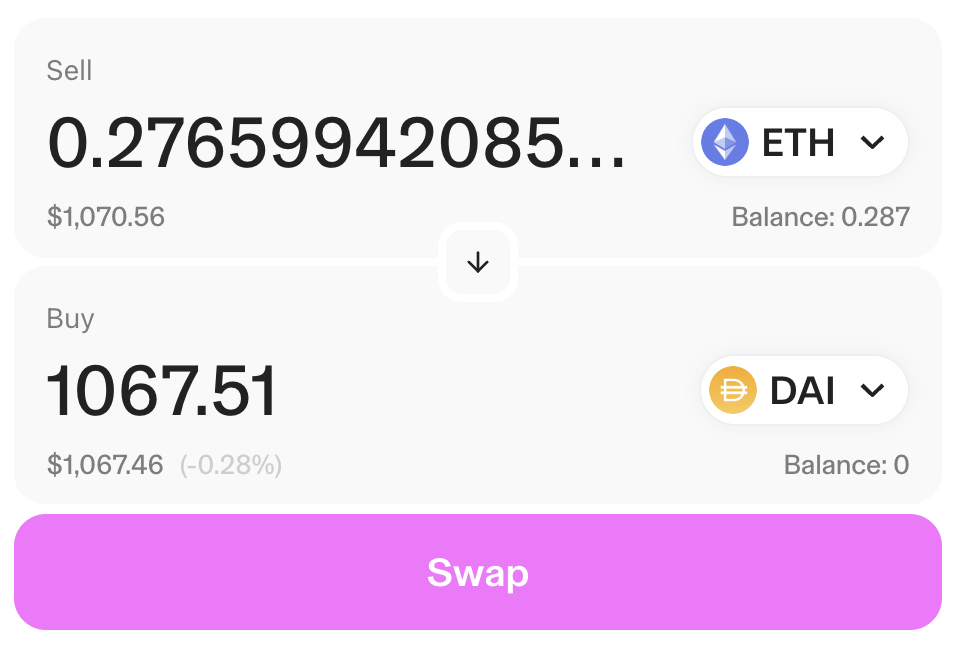
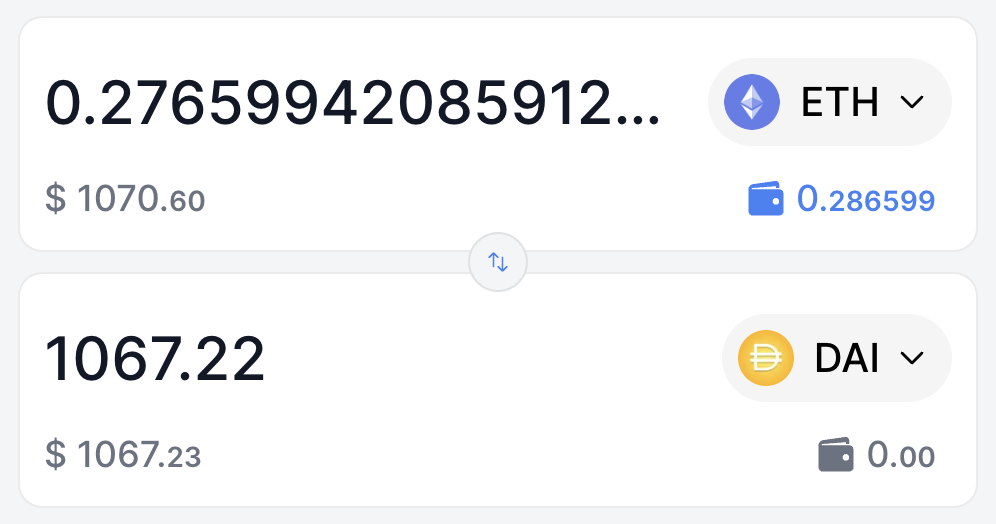
**Example:** As a very basic example of price deviations, we see below that the price for selling the exact same amount of ETH on Uniswap vs. SushiSwap is different. There is a $0.29 difference offered between SushiSwap and Uniswap on this trade. While this is a very minuscule example, the opportunity remains. This is the deviation opportunity that Private Pools Network capitalizes on.
{% endhint %}

<div><figure><img src="https://content.gitbook.com/content/rl3dSIdUNdPAk43XA8d6/blobs/bBIH8QDI9obGswR4IZap/Screenshot%202024-06-06%20at%202.51.26%E2%80%AFPM.png" alt=""><figcaption></figcaption></figure> <figure><img src="https://content.gitbook.com/content/rl3dSIdUNdPAk43XA8d6/blobs/ZbbNt03TsihmbaYrxKQT/Screenshot%202024-06-06%20at%202.51.33%E2%80%AFPM.png" alt=""><figcaption></figcaption></figure></div>

#### Rebalancing & Yield Distribution&#x20;

After the opportunity is executed by the trading engine and pools are rebalanced bringing them in sync with external market rates, the amount left over is treated as yield for the protocol and distributed according to our [Yield Distribution](/ecosystem/fees-and-yield-distribution) section.&#x20;


# Architecture

The Architecture page provides insight into the inner working of Private Pools Network. Here, more technically minded people can review the architectural fundaments of our project.

Private Pools Network operates with various components both online and offline. The key infrastructure, like asset security and hosting, is online. We use standard online contracts to manage liquidity, which have been reviewed for security pruposes. These contracts are based on the Balancer V2 framework but with some modifications to control who can access them. This ensures that only approved contracts can interact with the liquidity and execute the arbitrage exchange system.\
\
To further explore and define our system architecture, we have broken this down into two components:

{% content-ref url="/pages/r9nrt1YUYFptapSEzBbI" %}
[On-Chain Components](/ecosystem/architecture/on-chain-components)
{% endcontent-ref %}

{% content-ref url="/pages/Qp2ucqzPYkMDcuD2FWWY" %}
[Off-Chain Components](/ecosystem/architecture/off-chain-components)
{% endcontent-ref %}


# On-Chain Components

This page details the On-Chain components to our system architecture.

<details>

<summary>Index Liquidity Contracts (ILC)</summary>

These contracts are responsible for hosting the index funds and the weighted assets that compose them. These contracts are vital for the liquidity system, serving as a private counterparty in the arbitrage process. By design, these contracts are "**private**" & only accessible by our trading engine. We have leveraged these contracts as a means of enhancing the arbitrage process. Rather than interacting entirely with public liquidity pools (per the traditional arbitrage process), our system connects ILC's (Private Index Pools) with external liquidity pools for (value extraction), then leveraging ILC's as a means to rebalance a private pool to complete the arbitrage. This optimizes efficiency, as a significant portion of arbitrage value is typically lost to validators in the [Priority Gas Auctions](broken://pages/X3tqsKLlaUA5F4eIqiDV#priority-gas-auctions) (PGA's). The Private Pool Network leverages ILC's to ensure efficiency in value extraction from volatility by maintaining private pools via arbitrage rebalancing and minimizing exposure to competing arbitrageurs.

At its core, the framework is built upon a reconfigured Balancer architecture. The selection of the Balancer system was deliberate, leveraging its well-established and battle-tested infrastructure, providing a secure foundation for the protocol. The fundamental structure underwent minimal modifications, primarily introducing whitelist parameters to the swap functions of the Automated Market Maker (AMM) logic. These parameters empower the protocol system to whitelist entities interacting with its liquidity. Consequently, only the protocol system has the authorization to execute the rebalancing sequence and capitalize on arbitrage opportunities, enhancing the security and control mechanisms of the overall framework.

</details>

<details>

<summary>Arbitrage Rebalancing Contracts (ARC)</summary>

Arbitrage Rebalancing Contracts are contracts hosting the product's arbitrage capital engage when specific parameters within the system match the criteria to initiate the arbitrage rebalancing sequence of the Index Liquidity Contracts. Once initiated, ARC contracts will interact with ILC contracts until the rebalancing criteria are satisfied.

* Each strategy has a dedicated smart contract since every strategy differs in logic. An additional factor in separating strategy contract environments arose to enhance memory management and address concerns of byte-code length. This precaution prevents the byte code from becoming too large to be published on the blockchain if all the logic was to fit into a single contract. Furthermore, it allows for simplified management of each strategy and updates to it since all the contracts are maintained as a separate environment. &#x20;
* The global arbitrage contract is the system that oversees and allows management of the individual arbitrage strategy contracts. Its role is to select the specific strategy contract for executing the rebalancing sequence deemed most profitable by the off-chain engine.&#x20;

</details>

<details>

<summary>Profit Distribution Contracts (PDC)</summary>

Accumulated profits from liquidity arbitrage and index rebalancing are distributed via PDC. The system automatically deposits profits there as they are generated. The share of the profit distribution is decided by the percentage share of the liquidity pool and the time length of participation.

</details>


# Off-Chain Components

This page details the Off-Chain components to our system architecture.

<details>

<summary>User Interface  (UI)</summary>

User Interface is hosted on a dedicated server. The sole responsibility of that server is only to host the UI. This is done to mitigate the risk of overloading the server charged with maintaining the UI with other protocol activity and avoid security risks to other components by hosting them on separate hardware.

</details>

<details>

<summary>PrivatePools SDK</summary>

The SDK's purpose is to interact with the protocol's ILC, allowing users to deposit, withdraw, and harvest rewards. It is an extension of the Balancer framework, allowing us to adopt a secure and tested system for interacting with the contracts' ILC.

</details>

<details>

<summary>Subgraphs  </summary>

The Private Pools Subgraphs track event interactions within the ILC to query and store the data streaming from the contracts regarding pool balances occurred trades, and deposit/withdraw historical values. For gas efficiency, events are only triggered in the ILC; APIs are utilized for other contracts within the system.

</details>

<details>

<summary>APIs</summary>

As part of the development effort to make the protocol more operationally effective internally, we developed specific software optimizations, such as our APIs. The APIs are utilized for gas efficiency, allowing the protocol to read data directly from the full nodes instead of triggering events inside the protocol's smart contracts. The API collects ARC's trade data from the chain's full nodes, decodes it, and indexes it to Private Pools'. Reducing the need to trigger events inside the smart contracts eliminates extra gas expenses that would otherwise be required, maximizing profitability.

</details>

<details>

<summary>Smart Order Routing (SOR) </summary>

Smart Order Routing is part of the core infrastructure of the Protocol. SOR is an automated process utilized in electronic trading to find the best possible opportunity across the available liquidity venues for settling the trade relying on the defined configurations. As the liquidity venues within the Private Pools system expand and the protocol and users create more available offerings, SOR will become critical to effectively managing and settling the liquidity across all available sources internally and avoiding liquidity fragmentation. In the Private Pools protocol, SOR carries the same responsibility for routing trades through the liquidity environment and finding the most efficient trade route within the system. By routing through all of the protocol's available liquidity, existing pairs in the platform are arbitraged across all of the system's liquidity, maximizing capital efficiency.

</details>

<details>

<summary><a href="#trading-engine">Trading Engine</a></summary>

Our Trading Engine is the logic that operates and engages the arbitrage rebalancing mechanism behind the ARC is hosted off-chain on a separate high-security performance server to protect the protocol's IP. This module is responsible for trading logic and detecting and executing profitable trades that fulfil's the required parameters. After a profitable trade, the module shares profits to the profit distribution contract.

</details>

<details>

<summary>Simulator Tool</summary>

One of the internal developments behind the Private Pools project was created to analyze asset correlations more effectively to determine better index compositions and apply different rebalancing strategies to composed index funds. The protocol will outsource part of this tool to the community to help them better study their asset holdings.

</details>

<details>

<summary>Profit Distribution Calculator (PDC)</summary>

Our PDC is the off-chain logic component of the profit distribution contracts determines the size of the profit share coming from the system operating activity. It operates by tracking the liquidity share of each participant within the ILC and weighting it against the time they have been in the ILC contract to calculate the dedicated share of that participant.

</details>


# Trading Engine

The heart of our ecosystem

The purpose of the Private Pools Network Trading Engine is to maintain the asset ratios of each individual [Private Index Pool](broken://pages/X3tqsKLlaUA5F4eIqiDV#private-index-pool) in alignment with the broader market and generate returns by executing rebalancing sequences throughout the arbitrage process (the means to which value is extracted from volatility). This engine is an independent system within the ecosystems architecture, comprising multiple sub-components that include both smart contract frameworks and [off-chain](/ecosystem/architecture/off-chain-components) logic modules.

<figure><img src="https://content.gitbook.com/content/rl3dSIdUNdPAk43XA8d6/blobs/afitPq6jE8jjNNERluJJ/Screenshot%202024-05-27%20at%204.04.21%E2%80%AFPM.png" alt=""><figcaption><p>The trading engine is the heart of our ecosystem</p></figcaption></figure>

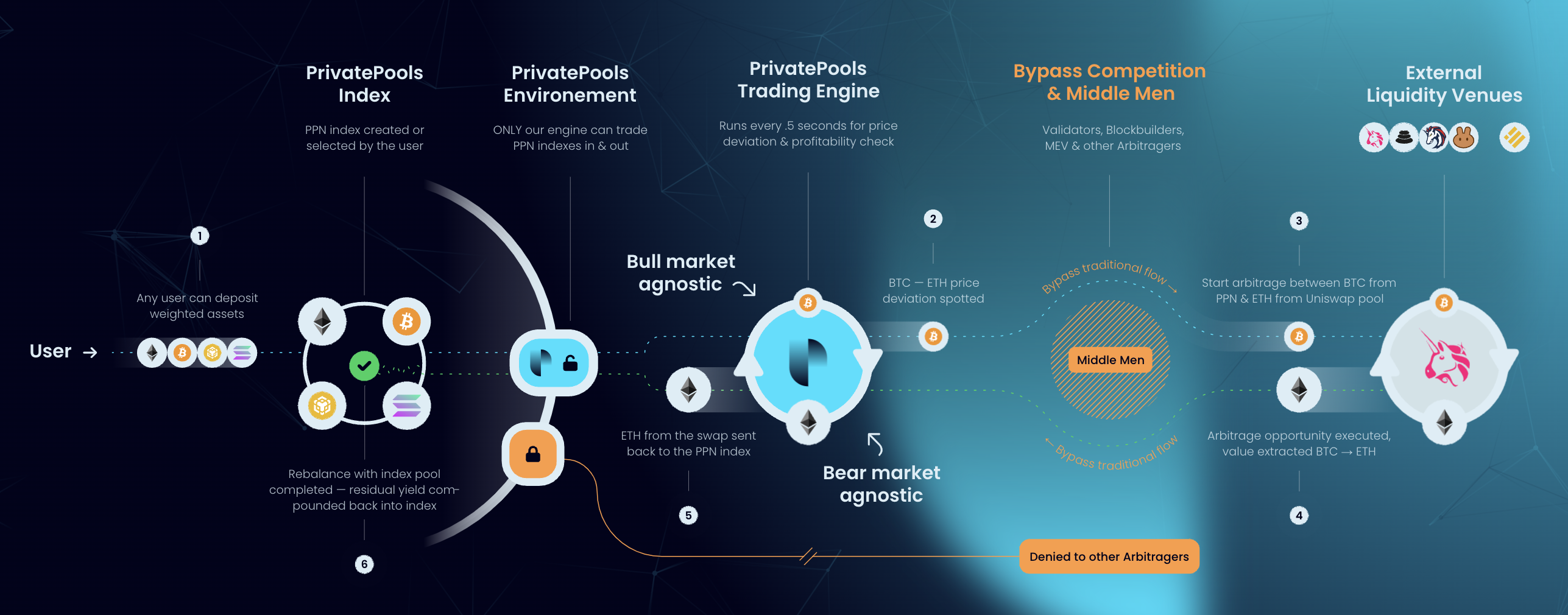
As depicted in the diagram above, the trading engine governs the logic for our strategy that extracts value from volatility. \
\
It is seeded with funds to execute arbitrage opportunities from [external liquidity sources](broken://pages/X3tqsKLlaUA5F4eIqiDV#external-liquidity-sources). It spots external arbitrage opportunities by querying pool balances within DeFi liquidity, and spreads on centralized orderbooks, every half a second. When its logic spots an opportunity to extract value from volatility, it will be triggered to either buy or sell from an external liquidity source, realizing the profit from executing each arbitrage opportunity, by rebalancing our Private Index Pools, just like any standard arbitrage process. \
\
By restricting access to our [Private Index Pools](broken://pages/X3tqsKLlaUA5F4eIqiDV#private-index-pool), enabling only our trading engine to interact with these pools, we establish a[ privatized order flow](broken://pages/X3tqsKLlaUA5F4eIqiDV#privatized-order-flow), which is what separates us from the rest. The benefit here is that in doing so, we not only cut out block builders and middle men (extracting up to 80% more value by circumventing [PGA's](broken://pages/X3tqsKLlaUA5F4eIqiDV#priority-gas-auctions)), but we also create value extraction opportunities that are exclusive to our ecosystem, eliminating competition as a result. \
\
This enables us to corner the market and monetize the negative effects of liquidity provision, extracting value that is otherwise lost in traditional LP's.&#x20;


# Fundamentals

The Functionality Overview page, where you'll discover the wide array of features and capabilities offered by our platform.

## Autonomous Index Funds

Private Pools Network provides full functionalities of an Index Fund on-chain. Users can create Index Funds with any crypto asset. Portfolios can be configured with a variety of assets at different weight scales. Our index funds are designed to operate autonomously, using algorithmic logic to constantly rebalance portfolios to configured weights, amplified by the process of Arbitrage. The resulting profits are distributed as yield to users of the Private Pools Network.&#x20;

## Real Yield Generation

In the process of portfolio rebalancing, our system executes arbitrage trades across DeFi and CEX liquidity sources. Through this process, our system maintains preset weights for the assets allocated into the index funds and generates returns, maximizing unitary asset values. These profits are then distributed to the liquidity providers & PPN token users.

## Flywheels and Positive Feedback Loops&#x20;

Our echosystem is designed to offer self propelling positive feedback loops baked into our ecosystem, by virtue of the $PPN token playing a pivotal role in driving momentum within our network. \
\
As outlined in the [Fees & Yield Distribution](/ecosystem/fees-and-yield-distribution) section of this document, 10% of all index yield is used to build momentum within our ecosystem, perpetually enhancing performance as the network generates yield.&#x20;

### How it works&#x20;

#### Trading engine capital&#x20;

The[ Trading Engine ](/ecosystem/architecture/trading-engine)is the heart of our [private order flow](broken://pages/X3tqsKLlaUA5F4eIqiDV#private-order-flow) model. The more capital it accumulates, the more opportunities it can arbitrage, which in turn generates more yield that is fed back into the trading engines capital reserves. This, in short, depicts the self propelling nature of the network and its ability to extract yield from volatility.&#x20;

<figure><img src="https://1180540342-files.gitbook.io/~/files/v0/b/gitbook-x-prod.appspot.com/o/spaces%2Frl3dSIdUNdPAk43XA8d6%2Fuploads%2Fu9L3kboQGrKjU38gbqHv%2Fimage.png?alt=media&amp;token=0f5c97b7-8a1d-42a6-92a6-4f54c6088683" alt=""><figcaption></figcaption></figure>


# Fees & Yield Distribution

Our Fee and Yield distribution is split into **5** categories, designed to establish a symbiotic relationship between our Private Pool Indexes, our exclusive Protocol Owned Indexes & the token itself. This system design results in multiple positive feedback loops that build momentum over time to propel the network in a self sustaining manner, irrespective of user adoption.&#x20;

<figure><img src="https://1180540342-files.gitbook.io/~/files/v0/b/gitbook-x-prod.appspot.com/o/spaces%2Frl3dSIdUNdPAk43XA8d6%2Fuploads%2FKCPH6FEK11e2QeybqkWb%2FX_Dist1.png?alt=media&amp;token=8c63bbc0-3afd-4517-826e-5f07082d29ca" alt=""><figcaption></figcaption></figure>

## Summary

Yield directly generated from volatility by virtue of our [private index pools](broken://pages/X3tqsKLlaUA5F4eIqiDV#private-index-pool) interacting with our [trading engine ](/ecosystem/architecture/trading-engine)is split as follows.&#x20;

### Index Yield 70%

70% of all value is compounded back into indexes. The logic here is to ensure liquidity providers receive a lions share of the yield our network extracts. Compounding is an optional selection for users, however by compounding yield back into your index pool we achieve optimization benefits.

1. Compounding increases the unitary value of the entire networks potential to extract yield from opportunities created by volatility. The more value left in our ecosystem, the more value we are able to extract in the future (momentum).
2. Compounding your value will result in your position diluting the value extraction power and share of yield your position is entitled to vs those who passively harvest their positions.&#x20;
3. Compounding your position entitles you to a boost to your PPN emission allocation. As mentioned above the more value the ecosystem retains, the better our network is able to perform as such users who elect to auto compound their positions will be rewarded for their efforts to strengthen our network.&#x20;

### Network Fee 30%

The network fee logic aims to ensure the project has enough capital to be self sustainable, whilst also strengthening our trading engine capital and insuring ample rewards are sent to token stakers. Of the yield extracted 30% is routed through the network fee channels. They are broken down into four categories as follows, each designed to establish positive feedback loops to strengthen our ecosystem and reinforce the value of the PPN token.&#x20;

#### PPN Token Stakers 10% (1/3 of the Network Fee)&#x20;

10% of the ecosystems entire yield is directed to PPN token stakers, giving our token Omni properties. This is an incredibly powerful concept because this allows people to participate in our ecosystem even if they don't wish to have exposure to certain asset classes within our Indexes. The omnifarious opportunity this delivers means stakers can gain exposure to the yield from all our ecosystem's indexes without holding the underlying assets.&#x20;

{% hint style="info" %}
This effectively makes the PPN token an infinite call option on the value  extracted across all of our indexes
{% endhint %}

#### Network Owned Liquidity (POL) 10% (1/3 of the Network Fee)&#x20;

This segment is divided by a cross section of yield flow where: \
\
**50% of the Network Owned Liquidity yield flow is directed to our&#x20;**<mark style="color:blue;">**trading engine capital**</mark>**:** \
This capital is owned by the entire network and acts as a pool of capital for our trading engine to access inorder to execute arbitrage trades. Think of this as the initial capital used to engage any and all arbitrager opportunities our network executes. Growing this pool of capital is extremely important, because the larger the pool grows the larger our trade execution opportunities grow along side it.&#x20;

{% hint style="info" %}
More trading engine capital means we can scale the size of the arbitrage opportunities we execute.&#x20;
{% endhint %}

**50% of the Network Owned Liquidity yield flow is directed to :our&#x20;**<mark style="color:blue;">**Protocol Owned Indexes**</mark>**:**\
The protocol owned indexes are indexes that support the PPN token directly, pairing the PPN token with "Blue Chip" assets. This is also an important component to our ecosystems architecture as it establishes a foundation of value and ensuring resilience in all market conditions. You can read more about the effects this has on our tokens value in the [tokenomics](broken://pages/qMxuKpoPAPlRS6VWcafk) section of this document.&#x20;

#### Network Overheads 10% (1/3 of the Network Fee)&#x20;

10% of all yield extracted by the network is directed to a protocol treasury for servicing protocol overheads. The cost to running our trading engine and ensuring its maintenance and upkeep includes subscriptions to many infrastructure vendors such as BloxRoute, ChainLink, 1inch, private server infrastructure to name a few. Ensuring the protocol establishes enough income to support these maintenance overheads is imperative to the sustainability of our ecosystem.&#x20;

{% hint style="info" %}
Any surplus capital left in the network overhead treasury, will be directed to growing protocol owned indexes. Once Protocol Owned Indexes start to produce enough yield where 50% of the yield they produce can sustain all maintenance overheads, the 10% Network Overhead fee will be deprecated, with this additional yield being directed to PPN token stakers, effectively doubling the rewards that token stakers receive. &#x20;
{% endhint %}


# Roadmap

The following image represents a detailed roadmap for the development of PrivatePools Network.

<figure><img src="https://1180540342-files.gitbook.io/~/files/v0/b/gitbook-x-prod.appspot.com/o/spaces%2Frl3dSIdUNdPAk43XA8d6%2Fuploads%2F1bDtguQofszwNhRSEYeA%2Fimagem.png?alt=media&amp;token=c3fe1b45-bb21-41a0-ad62-a78709f35d8f" alt=""><figcaption><p>It describes our planned updates and improvements to be made to the PrivatePools Network protocol and ecosystem.</p></figcaption></figure>

As displayed in our roadmap, PrivatePools Network plans on broadening its product offering along "with the ecosystem of projects under its umbrella." The synergies they create together are expected to increase the value of the $PPN token. A valuable asset should help reduce reliance on high inflation, which is something that tends to hurt Decentralized Exchanges.

#### [*Milestone 1*](#user-content-fn-1)[^1] *(Q2 2024)* <a href="#phase-i" id="phase-i"></a>

* [x] **Finalize Implementation of CEX Routing Strategies**
* [x] **Improvement UX for Liquidity Providers**
* [x] **Profit Distribution Architecture**
* [x] **Launch Closed Beta Testing of the Product ($500K test capital)**

#### *Milestone 2 (Q3 2024)* <a href="#phase-i" id="phase-i"></a>

* [x] **Implementation of Limit Order Strategies CEXs**
* [x] **Implementation of IL Refunds**
* [x] **Roll Out Pool Referral Link System**

#### *Milestone 3 (Q4 2024)*  <a href="#phase-i" id="phase-i"></a>

* [ ] **Open Beta Launch** :gear:
* [ ] **Implementation of Limit Order Strategies on DEXs** :gear:
* [ ] **Private Seed Round** :gear:
* [ ] **Begin Work on Additional Automated Trading Engine Strategies** :gear:
* [ ] **Smart Contract Audit with** [**Cyfrin**](https://www.cyfrin.io/)&#x20;

#### *Milestone 4 (Q1 2025)*  <a href="#phase-i" id="phase-i"></a>

* [ ] **Implementation of a Flash Loan Strategies**
* [ ] **On-Chain Trailing Limit Orders Implementation**
* [ ] **Expansion of Centralised Trading Venues**
* [ ] **Implementation of CL Pools and Strategies**

#### *Milestone 5 (Q2 2025)*  <a href="#phase-i" id="phase-i"></a>

* [ ] **Dynamically Adjusting Arbitrage Deviation Thresholds**
* [ ] **Release of AggregatedTriangular Arbitrage Strategies**
* [ ] **Aggregated CEX Routing**

#### *Milestone 6 (Q3 2025)*  <a href="#phase-i" id="phase-i"></a>

* [ ] **Target Integration with RWA Platforms**
* [ ] **Roadmap V2 Release**

[^1]:


# Security

## Audits

The smart contracts and codebase that supports the Private Pools Network is currently being audited by [Cyfrin](https://www.cyfrin.io/). Links to the audit and results will be published once we have confirmation from the Cyfrin team.&#x20;

## Bloxroute Integration

Private Pools Network leverages our partners at [BloxRoute](https://bloxroute.com/). We use this architecture to secure our private order flow and mitigate risk of our order flow being exposed to a sandwich attack, causing loss of yield and even negative trade outcomes to occur. By placing our transactions with external liquidity pools, in private memory pools, broadcasting our transaction intentions to the blockchain is secured, mitigating risk of unfavorable outcomes from our arbitrage opportunities. <br>


# Airdrop

Private Pools Network will be allocating 2.5% of the total supply to a community airdrop to market our product & attract sticky liquidity

<figure><img src="https://1180540342-files.gitbook.io/~/files/v0/b/gitbook-x-prod.appspot.com/o/spaces%2Frl3dSIdUNdPAk43XA8d6%2Fuploads%2FPzMCfHGBy1Ts54y5zBL4%2Fimage.png?alt=media&amp;token=2e449328-3d75-4678-9c13-b7989472e34d" alt=""><figcaption></figcaption></figure>

Our airdrop is designed to educate, incentivise and onboard our community. The process to which our airdrop is conducted will be broken down into 2 main phases, with each phase designed to familiarise our community with our ecosystem and prime them for eventual liquidity onboarding with our network. These phases are as follows:&#x20;

* Community Odyssey Event - Designed to educate and saturate brand development&#x20;
* Liquidity Odyssey Event - Designed to transition our community to liquidity providers&#x20;

{% hint style="info" %}
Airdrop points will be farmed over these three phases with points eventually being redemed for $PPN tokens.&#x20;
{% endhint %}

## Airdrop Points

As has become the "airdrop standard" as of late, Private Pools Network has opted to utilize a points farming system as a preliminary means of acquiring the right to claim the PPN token at the conclusion of our Liquidity Odyssey Event.&#x20;

To prevent any "gaming" of our airdrop, logic for how points are allocated will remain private however the earlier you are, the larger allocation you can accumulate.&#x20;

## Phases&#x20;

### Phase 1: Community Odyssey Event&#x20;

The Community Odyssey Event is the first phase in our airdrop rewards process. Early adopters who participate in our Galxe quests and Mini Application. Tasks, quests and engagement mechanisms will be leveraged to incentivise community engagement and widen our brands reach during this phase.&#x20;

#### Purpose&#x20;

The purpose of this phase is to increase the intensity of our push to educate the wider market on four main aspects of our product&#x20;

1. The problem we are solving - [Impermanent loss](/overview/glossary#impermanent-loss) and exposure to [Toxic Order Flow ](/overview/glossary#toxic-order-flow)
2. The opportunity - The side of the arbitrage market and helping users understand that the value we extract from this market opportunity, represents the annualised loss realized by all conventional AMM LP's each and every year
3. The Solution - Educating users about the metrics to which our network harnesses to establish our [Private Order Flow](/overview/glossary#private-order-flow) business model.&#x20;
4. Priming users for LOE - Walk throughs and how to articles will feature heavily in the community odyssey phase. This aims to familiarise users on how to interact with our ecosystem to maximise the unitary value of their crypto holdings. This aims to cultivate a smooth transition into the Liquidity Odyssey Event.&#x20;

The ability to earn points during this phase will be split between **Galxe** quests & task management through our **Telegram mini app**.&#x20;

#### Ways to earn points during the community odyssey event

**Galxe**\
Each piece of educational content we release during our community odyssey event will come with quests attached. These quests will range from sharing our social media posts, completing quizzes, & participating in educational content we push during this phase of the air drop process. Each quest will be allocated a set amount of points based on the quests importance and difficulty. The more quests you complete, the more points you earn to go towards your airdrop claim.&#x20;

<figure><img src="https://1180540342-files.gitbook.io/~/files/v0/b/gitbook-x-prod.appspot.com/o/spaces%2Frl3dSIdUNdPAk43XA8d6%2Fuploads%2FH8QjwtNNgKQtnZsy8dmR%2FScreenshot%202024-07-29%20at%2012.27.48%E2%80%AFPM.png?alt=media&amp;token=c3b2acab-3e40-4a8c-8a89-2e3fd7c43fde" alt=""><figcaption></figcaption></figure>

\
**Telegram Mini App**

Our mini application is an engagement hub attached to our Telegram community, it will be used to engage, incentivise and educate users about our project. As community members are onboarded to our telegram channel, they will be instructed to interact with our mini application as a means of driving community engagement & sharing our product with peer groups, whilst earning airdrop points for completing quests and sharing our project with peers.&#x20;

<figure><img src="https://1180540342-files.gitbook.io/~/files/v0/b/gitbook-x-prod.appspot.com/o/spaces%2Frl3dSIdUNdPAk43XA8d6%2Fuploads%2FDRraaM3HVAsHAyfOVFS1%2FScreenshot%202024-07-29%20at%2012.23.09%E2%80%AFPM.png?alt=media&amp;token=affffde9-69b9-40ce-8893-41c8e0c40fab" alt=""><figcaption></figcaption></figure>

#### Ways to earn points in Phase 1

<details>

<summary>Claiming points: </summary>

A passive points claim will be awarded every 8 hours. Users can check in every 8 hours, update themselves on our ecosystem and development updates, claiming points in the process&#x20;

</details>

<details>

<summary>Gamification: </summary>

Our mini application will offer a gamified interaction opportunity for users to be able to wager their PPN Points in an in app "Crash game"

</details>

<details>

<summary>Quests: </summary>

Notifications surrounding our marketing and community engagement initiatives will be pushed to our telegram group, with quests surrounding these initatives pushed to offer bonus points for people who complete these quests, contributing to our community network marketing efforts. This may include quests such as sharing tweets, completing a quiz & engaging in AMA's.

</details>

<details>

<summary>Referrals: </summary>

Points will be earned by users who refer their friends and community groups back to our Telegram channel. This incentivises spreading the word about our unique approach to solving the liquidity issue and building awareness around the notion of volatility farming.&#x20;

</details>

### Phase 2: Liquidity Odyssey Event&#x20;

The Liquidity Odyssey Event is the final destination for our airdrop questers. This phase involves priming users to interact with our UI and educating them on how interacting with our system works. This involves a variety of "how to" articles and explainer videos so our growing community are primed to use our system once our Liquidity Odyssey Event goes live.&#x20;

Participating in the liquidity odyssey event is MANDATORY to receive the airdrop, with majority of the airdrop allocation being dedicated to this phase in the airdrop initiative.&#x20;

#### Ways to earn points in Phase 3

The liquidity Odyssey event has one way to earn points, by providing liquidity to our Indexes once the network is live. Following this, for a duration of 3 months, users will farm points as well as receive Real Yield from the indexes they deploy liquidity into.&#x20;

{% hint style="info" %}
Points for this phase will be allocated base on the following metrics with snapshots of each wallets liquidity size & time, taken at random. \
1\. Size of the users liquidity position in comparrison with all other users \
2.Time at which liquidity is retained in our ecosystem by each user\
3\. Reductions or additions to liquidity over the Liquidity Odyssey Event &#x20;
{% endhint %}

{% hint style="danger" %}
Removing liquidity during this time, will see your points allocations diluted by others who retain their position or add more liquidity to their position during the duration of the Liquidity Odyssey Event.
{% endhint %}

### Claiming Your Airdrop&#x20;

At the end of the the 3 month Liquidity Odyssey Event our $PPN TGE will occur and tokens will be available to buy / sell on the open market. A claim page will be offered to users who have participated in each phase of our air drop initiative where points are redeemed for tokens. From here air drop participants have 3 options.&#x20;

1. Stake the PPN token in our network vault to receive 10% of every single Indexes Yield&#x20;
2. Pair the PPN token in one of our ecosystem Indexes, arbitraging and extracting yield from those who opt to sell their PPN tokens&#x20;
3. Sell the PPN token allowing those who chose option #2 to arbitrage the volatility you create in the process&#x20;

## Emissions go Live&#x20;

As the Liquidity Odyssey Event concludes, farming of points will switch over to farming of the PPN token. Those who keep their liquidity in our Indexes after the TGE will receive additional APR by virtue of $PPN incentive emissions.&#x20;


# dApp and Socials

Website (Landing) URL: <https://privatepools.network/>

X (Twitter): <https://twitter.com/PrivatePoolDeFi>

Medium: <https://medium.com/@privatepoolnetwork>

Discord: <https://discord.gg/ramses>


# Media Kit

## PPN Logo

**PNG Version**

<div><figure><img src="https://content.gitbook.com/content/rl3dSIdUNdPAk43XA8d6/blobs/VWoAOqckCmq1qwqGk939/logomark-accent@4x.png" alt=""><figcaption></figcaption></figure> <figure><img src="https://content.gitbook.com/content/rl3dSIdUNdPAk43XA8d6/blobs/0KaRMBmY7VdfqQyc5T7M/logomark-dark@4x.png" alt=""><figcaption></figcaption></figure> <figure><img src="https://content.gitbook.com/content/rl3dSIdUNdPAk43XA8d6/blobs/kK27N22qxzpgCSORcekf/logotype-accent@4x.png" alt=""><figcaption></figcaption></figure> <figure><img src="https://content.gitbook.com/content/rl3dSIdUNdPAk43XA8d6/blobs/z8DwriKI5Ea4uQE3bX2w/logotype-dark@4x.png" alt=""><figcaption></figcaption></figure></div>

**SVG Version**

<div><figure><img src="https://content.gitbook.com/content/rl3dSIdUNdPAk43XA8d6/blobs/n7wuQgXgsQ99i0MmTw9h/logomark-accent.svg" alt=""><figcaption></figcaption></figure> <figure><img src="https://content.gitbook.com/content/rl3dSIdUNdPAk43XA8d6/blobs/EmZhPeO90PGag71huthF/logomark-dark.svg" alt=""><figcaption></figcaption></figure> <figure><img src="https://content.gitbook.com/content/rl3dSIdUNdPAk43XA8d6/blobs/Yywb0dSSleiyvxn1e82q/logotype-accent.svg" alt=""><figcaption></figcaption></figure> <figure><img src="https://content.gitbook.com/content/rl3dSIdUNdPAk43XA8d6/blobs/vAchxqrNYhnKTGly6Gpl/logotype-dark.svg" alt=""><figcaption></figcaption></figure></div>


# Legal Disclaimer

## On-Chain Disclaimer for Early Users and Testers

By interacting with this platform, you acknowledge and agree to the following terms and conditions: Use at Your Own Risk: This platform is provided on an "as is" and "as available" basis. It has not undergone any formal security audit. You are solely responsible for any risks associated with using this platform, including but not limited to the risk of loss of funds.

**No Liability:** The developers, contributors, and affiliated parties of this platform shall not be held liable for any direct, indirect, incidental, special, consequential, or punitive damages, including but not limited to loss of funds, data, use, or other intangibles, arising out of or in connection with your use of the platform.

**Acceptance of Risk:** By using this platform, you agree that you understand the experimental nature of the software and that you are fully aware of the risks involved. You accept full responsibility for any and all outcomes resulting from your use of the platform.

**No Warranties:** There are no warranties or guarantees provided with this platform, either express or implied, including but not limited to warranties of merchantability, fitness for a particular purpose, or non-infringement.

**Assumption of Loss:** You acknowledge that there is a possibility of significant financial loss when using this platform. You agree to hold harmless and indemnify the developers, contributors, and affiliated parties from any claims or damages resulting from your use of the platform.

**User Responsibility:** You are responsible for conducting your own due diligence and understanding the risks before interacting with the platform. You should not use this platform unless you can afford to lose your entire investment.

By proceeding to use this platform, you indicate that you have read, understood, and agreed to these terms and conditions.